Unlocking Next-Generation Cloud Data Governance: How Amazon S3 Annotations Bridge the Gap Between Storage and Metadata Management

Data governance in modern cloud computing has long suffered from a structural disconnect. While organizations store massive volumes of unstructured and structured data within Amazon Simple Storage Service (Amazon S3), the critical context defining that data—such as classification levels, regulatory retention policies, geographic jurisdiction, and personally identifiable information (PII) inventories—typically resides miles away in separate relational databases or cataloging engines. This separation introduces architectural friction, latency, synchronization challenges, and vulnerabilities during compliance audits.
To solve this persistent industry challenge, Amazon Web Services (Amazon S3) has introduced S3 annotations, a native capability designed to bridge the gap between object storage and metadata management. By allowing organizations to attach robust governance contexts directly to individual S3 object versions without rewriting the underlying payloads, this feature fundamentally reshapes how cloud architects approach data security, regulatory compliance, and lifecycle management.
The Mechanics of S3 Annotations
Unlike legacy object tags or static user-defined metadata, Amazon S3 annotations offer an expansive capacity designed for enterprise-grade record-keeping. A single object version can accommodate up to 1,000 unique annotations. Each annotation acts as a UTF-8 payload ranging from 1 byte to 1 megabyte in size, supporting structured formats such as JSON, XML, YAML, or plain text.
This spacious payload removes the historical constraint of squeezing governance requirements into rudimentary key-value pairs. Instead, data stewards can embed comprehensive audit records directly onto the data asset. For example, a contract document stored in a governed S3 bucket can carry a structured JSON annotation outlining its schema version, confidential classification status, exact retention schedules (such as a seven-year corporate contract rule), data residency region (e.g., eu-west-1), PII categories present within the file, and human-verified rationales for its compliance posture.
Furthermore, S3 annotations are fully mutable. When an asset undergoes reclassification, compliance review, or status updates, the enrichment pipeline executes a PutObjectAnnotation API call to update the context in place. This modification occurs without altering the object’s binary content, modifying its cryptographic entity tag (ETag), or forcing an expensive re-upload of the file. Cross-Region replication configurations also respect these changes, automatically propagating the updated annotations alongside the parent object provided the proper replication roles are provisioned.
The Reference Architecture: Event-Driven Enrichment and Querying
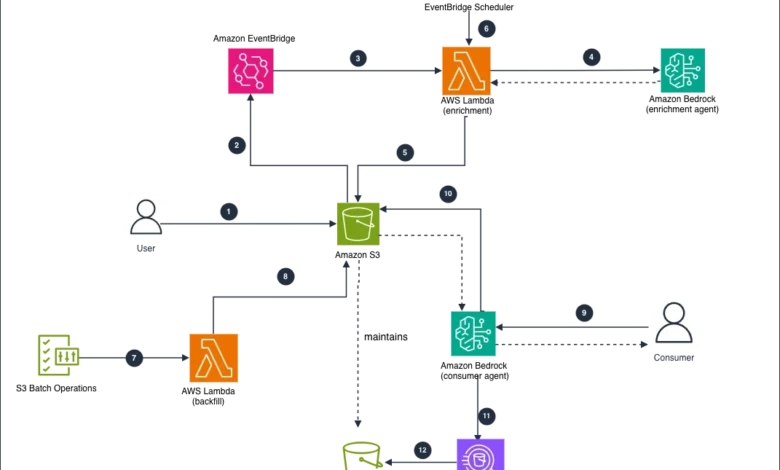
Implementing S3 annotations at scale relies on a robust, event-driven reference architecture. Typically, this pattern comprises four distinct operational paths: a write path for incoming objects, a maintenance path for ongoing context updates, a backfill path for legacy assets, and a read path for downstream consumers.
When a new object lands in a governed S3 bucket, an event notification triggers an automated enrichment service. This service analyzes the file, generates the appropriate governance record, and writes the metadata via the S3 annotation API. For assets that predate the automated pipeline, a batch backfill utility executes parallelized API calls to bring historical data up to modern compliance standards.
For enterprise-scale querying, organizations can activate an S3 Metadata annotation table via bucket metadata configurations. Powered by Amazon S3 Tables and backed by open-source Apache Iceberg, this integration allows data analysts and compliance officers to execute standard SQL queries across millions of objects using tools like Amazon Athena. Instead of querying an external database or performing slow object scans, auditors can instantly filter datasets based on specific annotation criteria, such as identifying all expired contracts containing unencrypted PII.
Critical Design Behaviors and Security Guardrails
While the plumbing of S3 annotations is straightforward, cloud architects must navigate several nuanced platform behaviors to avoid costly operational mistakes. Industry best practices and AWS documentation highlight key operational principles:
-
Version-Scoped Deletion: Because annotations are bound strictly to specific object versions, they do not automatically vanish when a standard
DELETErequest is issued. In a versioned bucket, deleting an object without a version ID simply creates a delete marker while leaving the underlying version and its annotations intact. Compliance teams executing right-to-be-forgotten workflows must explicitly target version IDs or configure lifecycle rules for noncurrent version expiration. -
Object Lock Freezing: S3 Object Lock operations take precedence over metadata updates. While a file is under active retention in either Compliance or Governance mode,
PutObjectAnnotationandDeleteObjectAnnotationcalls are denied. Consequently, architects must ensure that complete governance records are authored and attached before locking an object version. -
Multipart Copy Nuances: Standard
CopyObjectoperations transfer annotations automatically for files up to 5 GiB. However, large-file copies executed via multipart upload—commonly utilized by AWS SDKs and the AWS CLI—drop annotations by default unless administrators explicitly opt in using parameters like--copy-props all. -
Cryptographic Constraints: S3 encrypts annotations using the same underlying encryption configuration applied to the parent object. However, objects encrypted via customer-provided keys (SSE-C) do not support annotations. Organizations scaling governance initiatives are encouraged to migrate legacy SSE-C workflows toward server-side encryption managed by S3 (SSE-S3), AWS KMS (SSE-KMS), or dual-layer KMS (DSSE-KMS).
-
Strict IAM Privilege Separation: Security best practices dictate that read, write, and delete permissions for annotations must be strictly segregated. Granting
s3:DeleteObjectAnnotationshould be restricted to dedicated administrative roles equipped with multi-factor approval workflows, whereas enrichment agents should possess write privileges and general consumers should be limited to read-only actions.
Industry Implications and Cost Analysis
The introduction of S3 annotations signals a broader industry shift toward decentralized, self-describing cloud storage architectures. By eliminating the operational overhead of synchronizing external metadata stores with cloud object storage, enterprises can significantly reduce architectural complexity. Systems integration overhead drops, latency in compliance reporting disappears, and data portability improves since contextual governance rules travel directly with the file across accounts and regions.
From a financial perspective, organizations must factor storage and request pricing into their total cost of ownership. S3 stores annotations at standard S3 storage rates regardless of the parent object’s lifecycle tier—meaning an annotation attached to an object in S3 Glacier Deep Archive will still incur S3 Standard storage fees. Additionally, because annotations replicate and copy independently, bulk data transfers involving heavily annotated datasets will incur request-level charges proportional to the total annotation count.
Conclusion
Amazon S3 annotations transform how organizations approach cloud data governance by marrying metadata directly to the data asset. By understanding version-scoped lifecycles, maintaining strict IAM permission boundaries, and leveraging integrated SQL querying capabilities via S3 Tables, enterprises can achieve unprecedented visibility and control over their cloud environments. As regulatory scrutiny intensifies globally, native object-level annotation stands out as a foundational pillar for next-generation data management.